
Welcome to the series of How To:Quality. Your 3 min guide on how Quality Professionals address various business needs to drive Improvement and Governance.
Quality Professionals, regardless of the sector they work in, strive to help businesses achieve their strategic objectives. They do this in various ways: be it deploying governance frameworks, implementing improvement strategies, or delivering assurance programmes.
In this edition, I share simple steps you can follow to write a meaningful policy that related to the context of your organisation. I also provide a template you can download and use for free.
How to: Quality
It is very easy to roll your sleeves up and dive straight into improving processes and conducting assurance activities for projects or organisations you just join. While in some instances, doing so is necessary, as a whole, I highly suggest taking a step back and looking at the strategy you will take to achieve the ultimate outcome. Here is where having a policy in place helps.
For me personally, many businesses work with audits and have guidelines for incident management. As a Quality Professional, how good you are at writing a policy that is suitable for the context you are in is extremely valuable. As a CEO / Business Leader, how much you involve your Quality Professional with your organisational policy writing correlates to the success of that policy. Quality Professionals who are members of the Chartered Quality Institute work and abide by the competency framework and the profession map which outlines 5 pillars: context, leadership, governance, assurance, and improvement. Having a Quality Professional collaborating with business owners in policy writing is likely to bring you an increased collaboration and effectiveness in your policy. Here are few things you should consider when writing a policy.
- Policy Objective
- Policy Scope
- High level procedure / implementation guidelines
- Communication guidelines
- Qualifications where relevant
This is not a complicated science. All you are doing is asking questions for the business to answer, and your policy is formed. If you work with ISO 9001, this is your Quality Policy. If you work with any other standard, treat this document as your Project Charter. The best way to think of writing a policy is to take your reader through the funnel process. Starting from the wider remit narrowing it down to the relevant detail. It is a journey, which I read a company illiustrate best when they were talking about best ways to create learning material.

Policy Objective:
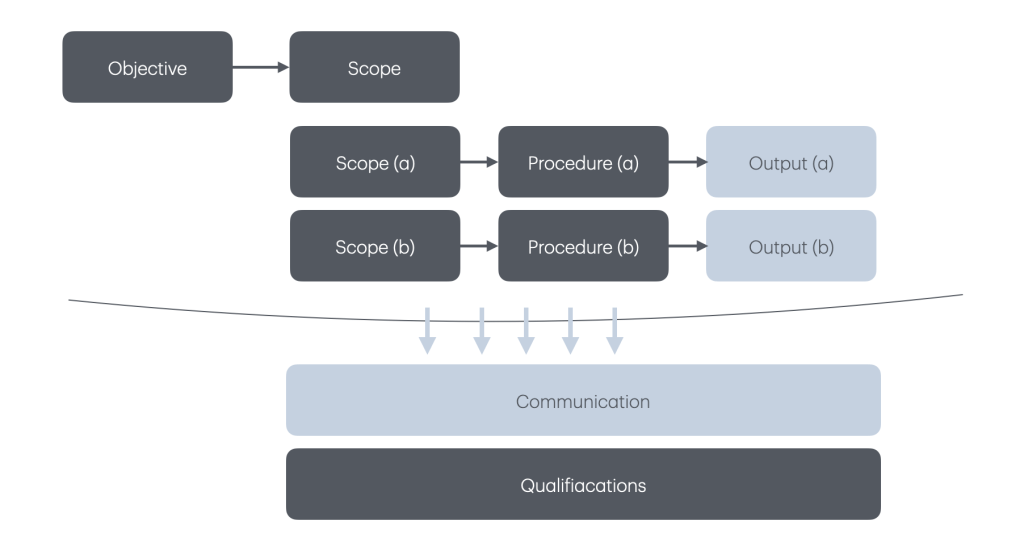
This is my first point of assessment on whether the policy is aligned with the business strategy. I am not looking for the vision and mission statements to be listed in this section. I am looking for the ‘why’. Why do you have this policy in place. What is it you wish to achieve that would support the deployement of the business strategy as a whole.
Policy Scope:
This section should answer the question: What does this policy apply do? or What is covered in this policy? It should also be clear as to what this policy will not cover. There has to be a clear synergy between the objective and scope. Take for instance a software development company that wants to be the leading organisation in software development that is based on low code/ no code. If you are developing a Quality Policy for this organisation, you need to ensure that your scope covers production in all its aspects: product development, voice of customer, quality control processes, error fixing, etc. All of this is in the scope to ensure the organisation can obtain its leading status. I would expect that when I read the company’s strategy, the term leading is defined.
High Level Procedure
This is when you tell your reader how you will go about implementing this policy. In the learning funnel shared above, this is the third layer down: implementation. My suggestion for you to get this section is to fill in the blanks:
I will ensure the policy scope is achieved by ________ in order to obtain __________
Let’s try it on the leading software development which is putting in place a Quality Policy
- I will ensure the policy is met by implementing an audit framework in order to obtain information on the product viability and readiness to market early stages.
- I will ensure this policy is met by implementing an produce development control process in order to be able to fix product issues early on without hindering customer experience.
When you map your thought process using the above sentence, you can them tidy up your scope section accordingly. If you are implementing a specific policy i.e. not a business wide company policy, you can follow the same approach, but narrowing the funnel down further.
You work does not stop here though. For me, this is the meatiest section in your policy. It should tell me How the policy is implmented. I would expect to see high level steps, stages, of gateways that I would recognise if I look at any evidence or process that is in use anywhere the scope is covered. If you have timeframes associated with some of these procedures, then make sure you surface them, especially if they are key to the outcome delivered. Here is a diagrame that illustrates all these pillars.
This leads us to the next section.
Communication Guidelines
If your policy does not have any information to communicate with stakeholders, you have an ill-fitting policy. You need to go back to the drawing board. Remember, a solif governance framework operates in line with an organisation context. This context has to be at the front of your prolicy’s output and ourcome.
What will I communicate with who, and when do they need this information by?
If you answer the question above and consider all your stakeholders, you have got your section populated.
Qualifications
This section is an optional one, which you can use only where applicable. I tend to see this section in policies that are very skill specific. For instance, running an audit programme, you would want to see a section that explains who is authorised to conduct the work outlined in section three.
If you enjoyed this How To scenario, why not follow me for other scenarios dropping straight into your inbox 👇
If you would like to see a particular topic covered in this series, please get in touch and let me know the topic or scenario, and I will do my best to help. You can get in touch on your preferred platform 👇

 the Quality strategy
Leave a comment