
Gaining practical experience from the field is extremely powerful. When this experience is married up with research, theory, and clearly defined frameworks, the experience gains further heights.
I have a list of books recommended to me and not enough time. But this book is one that I wanted to tap into it because of the impact Customer Experience management has on businesses. And with the Chartered Quality Insitute partnering up with Gartner to produce the research* into alignment of CX with Quality 4.0, this takes significant importance.
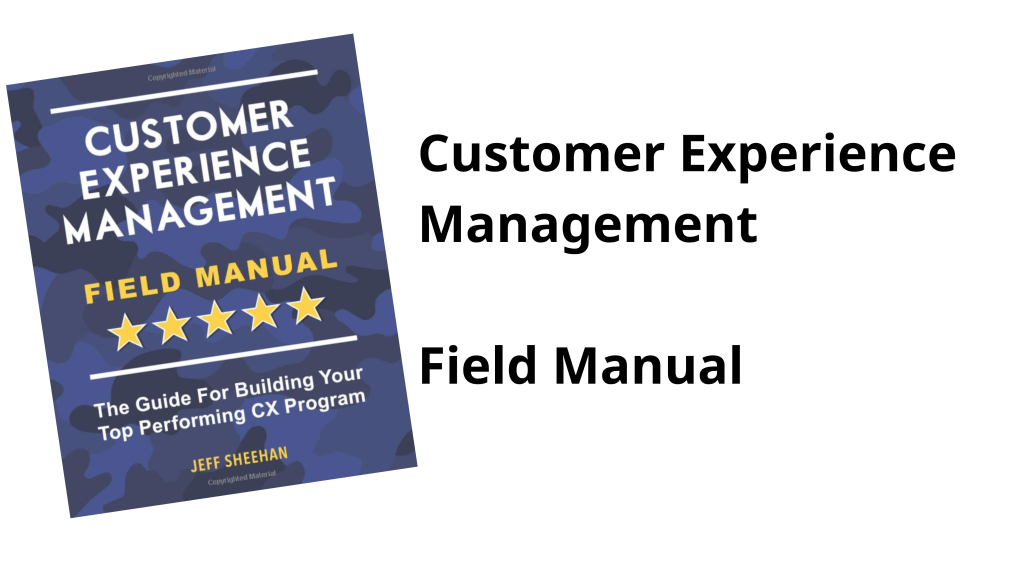
For every change programme, strategy is essential. Leaders have to be well versed and well articulate in communicating the what, why, where, when, and how. Having the strategy in place is one thing and communicating it is another. Neither comes without their own challenges. Businesses wanting to differentiate themselves from others through customer centricity will have to do so with strong leaders in place. In this post, I will explore the CX Leaders skillset which Jeff Sheehan outlined in his book: Customer Experience Management – Field Manual.
In a truly customer centric organisation, there is a discipline for internal decision making done from an outside point of view, as if standing in the customers’ shoes. Operationally, every decision is driven by customer understanding, and the business results are the consequences of providing customers a more personalised experience. The big differentiator with customer centric organisations: the customer comes first in everything.
Customer Experience Management – Field Manual (Sheehan, 2021)
How do you bring your organisation and your team on this journey? This is a not an easy task and requires certain skillset. I am not going to talk about how to implement a CX programme, I want to focus first on the skillset you need. Sheehan explains in his book that CX leaders demonstrate 9 different behaviours. Before I share them with you, Sheehan states that there are several sources of authority a leader gains. I really enjoyed reading how he outlined them:
- Positional Authority
- Borrowed Authority
- Earned Authority
Positional authority, he explains, is what is associated with your position in the organisation. It is usually predefined in the organisation structure and comes part of the job description. Borrowed Authority, on the other hand, is usually provided when you are working on a certain initiative that has an executive sponsor. I believe that if you already have a positional authority as an executive leader, it is important you understand the power Borrowed authority has. Earned Authority, is the icing on the cake. This is one you are recognised in your organisation as the go-to expert in the field. This is earned because it requires time, and so many interactions with various stakeholders in the business.
In my early career, one of my line managers said: Rashad, you have to learn to work with the emotional bank in a team. The more you collect brownie points, the more you can exchange them when a conflict takes place, because people already know the collaboration you bring. This to me is a form of Earned Authority. It is what helps you build credibility out of many interactions where you demonstrated positive leadership skills.
So what are these leadership skills associated with a CX professional?
Sheehan outlines 9 behaviours and 8 skills CX leaders should be comfortable with. I list them in the table below:

All of these behaviours and skills are important. I want to unpick three: Inspire Change, Being Authentic, and Getting Kinetic.
For me personally, the core of all of these behaviours and skills is Being Authentic. Implementing a CX programme is at its core a change programme. Some people will be onboard from the get go while others will resist. As a CX leader you must be able to demonstrate the benefit of this programme and how they will overcome some of the obstacles people will bring to you. If you lack integrity, no matter how good you were with putting a facade, teams will soon lack trust in you and your programme. Being authentic and working with integrity will be a driving force in building and nurturing relations. Being authentic is the backbone of you Inspiring Change.
Having integrity will also help you with the earned authority we touched on earlier. Owning up to mistakes and wrong decisions will help you further your strategy. Doing so requires collaboration, interaction, networking, listening, speaking, questioning, challenging, researching, and communicating your strategy and the benefits of this CX programme. It requires you to be out there at the forefront of this programme. This is Getting Kinetic skillset. In one of my recent conversations with Eric Rueter, a project management professional, he said that a defining moment in a change programme they have embarked upon is when they owned up for an error that was made early on in the change programme. They had made a change which stakeholders found unhelpful. So as not to lose their engagement, they openly owned for this error which gave them a lease to operate and collaborate to drive a meanginful change.
In summary, being authentic is the easiest way to operate with integrity. It is one of the driving force for inspiring change. And to do so, you must be out there, collaborating, speaking, communicating, analysing, researching, listening to all your stakeholders to keep your programme alive.
*You can read more about the Gartner 7 CQI Paper on Customer Experience and Quality 4.0 here
If you enjoyed this article, why not follow me for other topics dropping straight into your inbox 👇
If you would like to see a particular topic covered, please get in touch and let me know the topic or scenario, and I will do my best to help. You can get in touch on your preferred platform 👇


 the Quality strategy
Leave a reply to Jeff Sheehan Cancel reply