
Welcome to the series of How To:Quality. Your 3 min guide on how Quality Professionals address various business needs to drive Improvement and Governance.
Quality Professionals, regardless of the sector they work in, strive to help businesses achieve their strategic objectives. They do this in various ways: be it deploying governance frameworks, implementing improvement strategies, or delivering assurance programmes.
In this post I talk about how Quality Professionals can help process owners prepare for an audit so they can get the most value out of the entire engagement.
How to: Quality
The world is moving into a more regulated environment, being it governmental regulations, professional institutes regulations, or societal imposed values that dictate on businesses to self govern and ensure customers’ values are met. How do businesses prepare and embark on a journey where they can meet regulatory requirements? or confidently say they self govern and guarantee their commitment to their customers value?
In this post, I will share how Quality Professionals can help organisations embark on that journey through these 5 steps. Equally, if you are a Quality Professional newly assigned to help your organisation’s audit process or accreditation journey, carry on reading.
- Understand the requirements you are committing to
- Conduct a self assessment
- Identify areas of strength and areas that require attention
- Implement see it, say it, do it methodology
- Engage with external parties where necessary
1. Understand the requirements you are committing to
Requirements that drive a business to conduct an audit can vary. Quality Professionals have a skill to understand these requirements. They could simply be business, regulatory, compliance, customer, government or supple chain mandated. Wherever they come from, understanding those requirements and what they mean operationally is essential.
Why do we start with this step? Quality Professionals are good at identifying synergies and commonalities between all requirements. They have the skillset to identify how one process (or a series of activities) can actually satisfy more than one requirement. Most importantly, Quality Professionals can synchronise and align all prerequisites so businesses look at one integrated set of requirements to perform efficiently and not be burdened with a fragmented long list of must haves and must dos.
2. Conduct a self assessment
This is your own evaluation on your business. This step helps you answer the following questions:
- Is it performing the way you expected it to perform?
- Are the processes behaving as planned? and
- Are the teams interacting with your processes fully aware of these requirements?
💡Checklist is the easiest tool to use for this step. Don’t complicate it, list all your requirements and map out your self assessment answers to the requirements in the checklist. It is a quick visual to let you understand where you need to focus
3. Identify areas of strength and areas that require attention
The self assessment step above is any business’ own gap analysis. Before focusing on gaps, Quality Professionals are equipped to identify strengths in the process. They can helps leaders and process owners focus on the successes of the business. When a success is identified, it becomes easier to replicate it, or learn from it. Most importantly, the team behind a successful process or division becomes more encouraged and engaged to drive future improvement.
Having the mindset of identifying the business successes, makes it easier to tackle any gaps or areas that require improvement.
💡Risk Based Approach – while it is very tempting to address all the gaps and drive a huge wave of improvement, this approach is unlikely to be practical. Quality Professionals help businesses identify a risk assessment framework that gives you a priority of what areas you need to address first to satisfy the regulatory requirements.
💡It is ok not to address a gap IF the business has conducted a detailed risk assessment and clearly captured why a decision is made not to address a certain gap.
4. Implement see it, say it, do it methodology
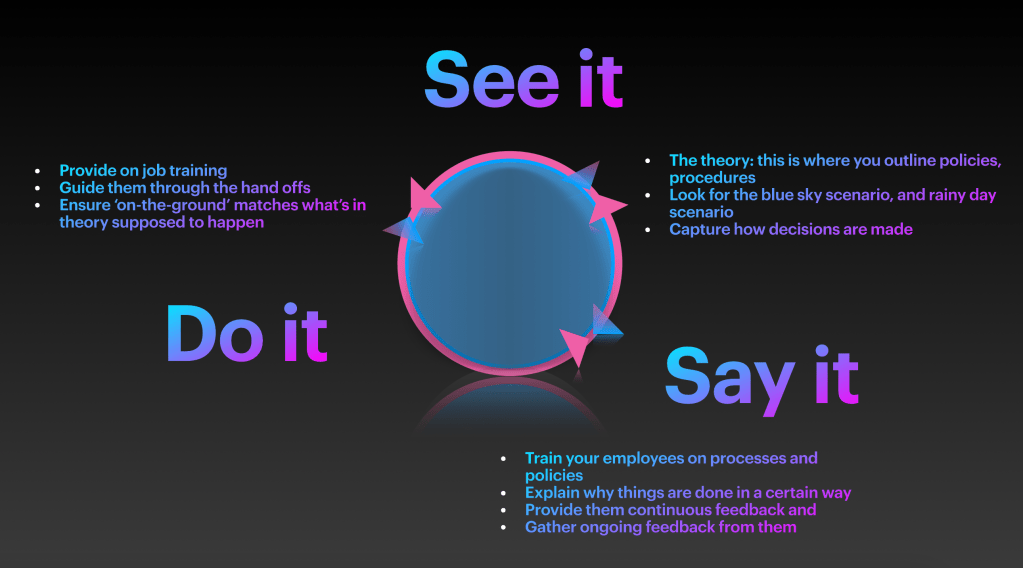
A simple framework to remember. Almost all auditors use it, and if you understand it, it becomes easier for you to help auditors or any regulatory body work with you.
The graph to the right explains the framework. You can start anywhere in this loop, and in any direction as well.
5. Engage with external parties where necessary
Your supply chain is an extension of your own business. If you do not include them in the process you are highly likely to miss some of the gaps and miss the opportunity to build on some of their successes.
Engaging with your supply chain does not need to be complicated nor complex. It all starts with a discovery session, sharing the business’s operational process of a particular regulation, and establishing a commitment the requirements. Make sure you prepare them for any audit before the process starts. They perform best when they are set up for success with the information they need.
If you enjoyed this How To scenario, why not follow me for other scenarios dropping straight into your inbox 👇
If you would like to see a particular topic covered in this series, please get in touch and let me know the topic or scenario, and I will do my best to help. You can get in touch on your preferred platform 👇


Leave a Reply