

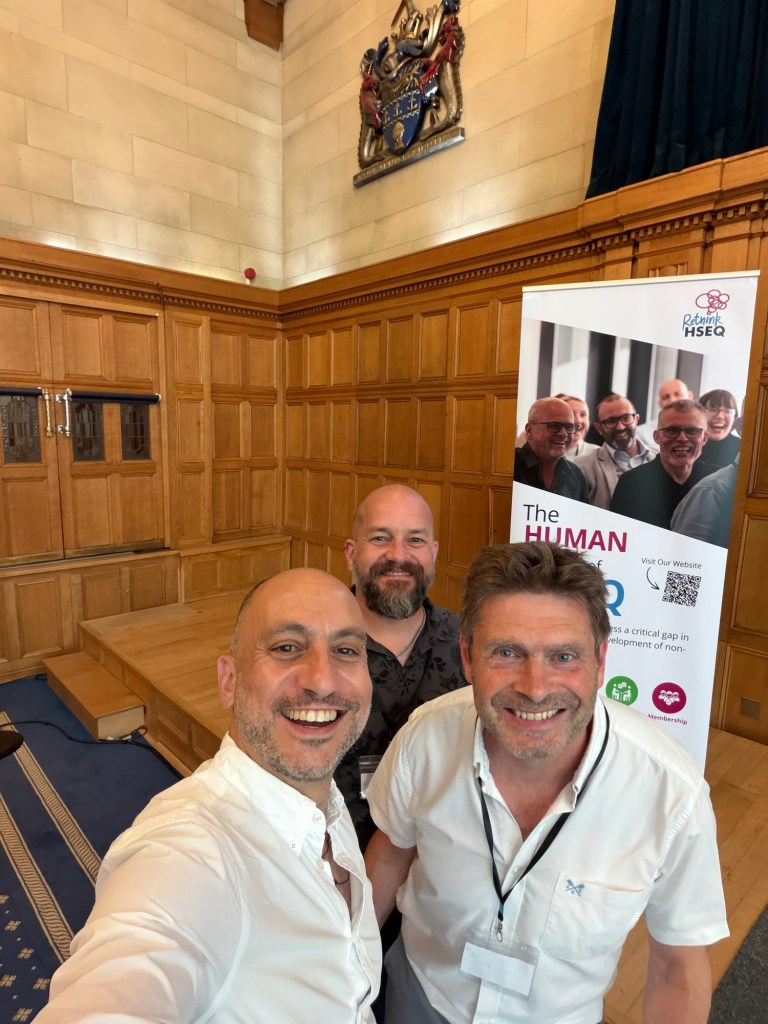
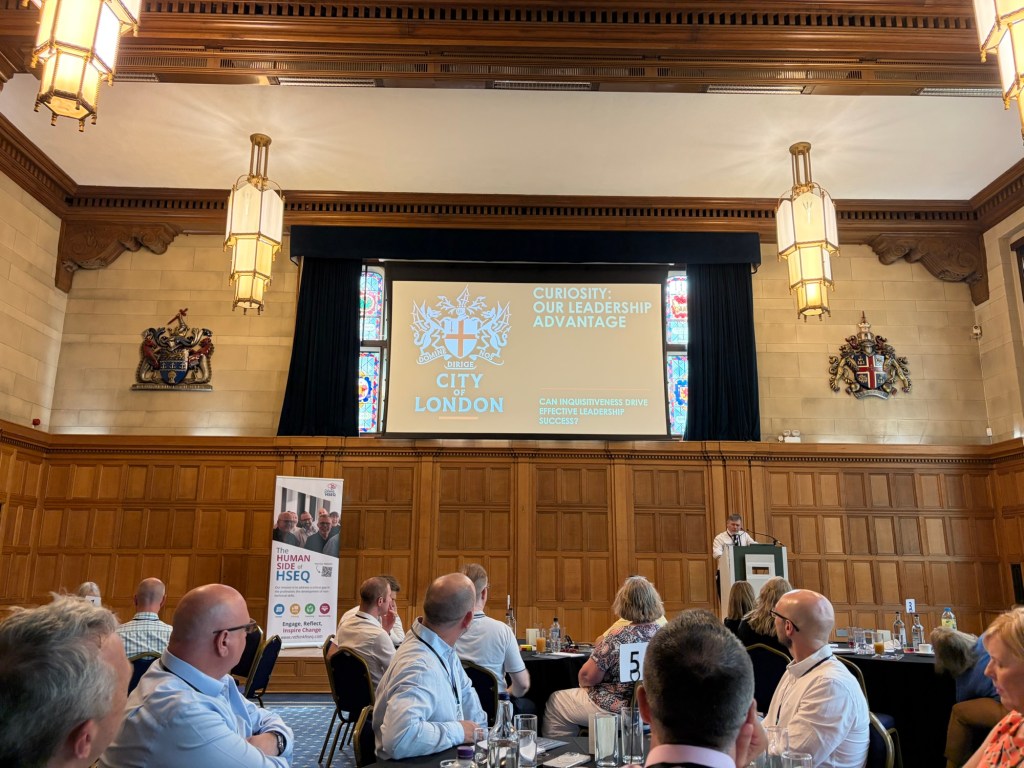
I spent yesterday at Rethink: Curiosity, a one-day event exploring something HSEQ rarely gives enough airtime to: curiosity itself. Not as a personality trait, but as a discipline. The day moved through three lenses: Mindset, Behaviour, and Impact, and each one left me with something worth sitting with.
In this post, I am sharing my reflections on the day, and explain the word of the month: Facipulation, so stay with me 😀.
Mindset: Safety is internal, Trust is external
Suzie Edwards opened with a distinction I haven’t stopped thinking about. Psychological safety is internal. It’s whether I feel able to share an idea without being judged. Trust is external. It’s whether I believe in you. They’re not the same thing, and conflating them is how organisations end up with teams that feel safe on paper but still don’t speak up.
She also introduced the idea of a curiosity tax: the cost an organisation pays, financially, physically, or emotionally, every time someone stops asking why. It’s rarely visible on a balance sheet, but it shows up in near-misses nobody flagged and assumptions nobody challenged.
One reframe I found powerful especially that in Quality we always encourage focusing on process: instead of asking “why didn’t you flag this sooner?” which closes people down; ask “what would have made it easier to report this sooner?” Same question, entirely different approach.
Behaviour: Culture and behaviour shape each other
Nick Skinner’s session reminded us of a simple hierarchy: legislation sets the floor, process gives structure, but behaviour — what we actually do and say — is where the real work happens. Culture shapes behaviour, and behaviour shapes culture right back. It’s not one-directional.
He placed manipulation and facilitation at opposite ends of the same continuum. Both are ways of influencing others, but one closes down thinking and the other opens it up. And many teams operate in the middle of this spectrum. Hence the term Facipulation. It is a term that I will be using a lot. Here is how he explained it:
A yes/no question is the approach for a manipulation environment.
An open ended question is the approach for a facilitation environment.
An open ended question with multiple choice is the approach most commonly used. It focuses the answers and aligns them to the paths offered in the answer choices. This in itself could also limit curiosity. But it is used to give some sort of control to organisations and leaders over the output. After all, humans prefer control over ambiguity. I found the interaction in this session very useful. Many leaders recognised that sometimes this approach is used mask facilitation and manipulate the engagement.
And Nick made a point that stuck: in a crisis, the only thing left to offer people is direction and certainty. Knowing when to instruct and when to stay curious is a leadership skill in itself because instruction, used too early or too often, can shut curiosity down before it starts. He explained that behaviour is shaped by four things: personality, role, situation, and culture. This four pillars are important to keep in mind when cultivating the right behaviours in organisations.
Impact: Autopilot isn’t the enemy, unquestioned autopilot is
Clare Inkster’s session brought it home. We rely on autopilot because questioning every decision, every day, would be exhausting. That’s not a flaw, it’s how humans function. The risk isn’t autopilot itself; it’s forgetting we’re on it, especially as we quietly hand more decisions over to AI without noticing.
Her point that noticing isn’t passive, it rewires your brain is one I’ll be repeating. And her practical takeaway was the most actionable of the day: run experiments that are intentional, time-boxed, and reversible. Two weeks is often enough to gather real data, learn from it, and act. The approach we take to experiments mirrors the PDCA cycle every Quality professional and HSE leader is fully aware of.
My Curiosity vs Others
The session has really made me think about instances I stopped asking why; about instances where I am certain something would go wrong and how to approach it. Most importantly, it made me think about what I need to do to cultivate curiosity in the wider teams and organisations I work with. Cultivating Curiosity could be difficult at times, but it is far more difficult if it is done single handedly. So thinking of it as a journey of continuous reflections and adjustment is what I will be doing.
Curiosity in HSEQ isn’t a soft skill. It’s a decision-making one and yesterday was a good reminder of how easily it erodes without us noticing.
A massive thank you to Shirley Parsons and team for putting on such a great day. Everyone from Shona, to Mike, Jerry, Emily, Mike and Oliver have been absolutely brilliant in hosting all of us.
If you have done so yet, make sure you subscribe to my get my articles as soon as they are published. I talk about Quality Management, Project Management and Strategic Leadership.




Comments
One response to “Facipulation: Bridging Curiosity and Leadership in HSEQ”
[…] asks leadership to own that visibly. It’s the same shift I explored from a different angle in Facipulation: bridging curiosity and leadership, leaders can’t out-source culture to a […]
LikeLike