
The Question Nobody Asks the Quality Leader
Finance has business partners. HR has business partners. Most leadership teams wouldn’t think twice about pulling their Finance Business Partner into a strategy conversation. The Quality Leader, meanwhile, often gets the invitation after the decision has been made, to “make sure we’re compliant.”
I’ve been in that position more times than I’d like to admit. For a long time, I assumed the fix was technical: better data, tighter systems, sharper assurance programme. But the more I anchored my leadership style with strategic support, my reality changed. My experience with Everything DiSC since 2006 gave me a language for why some quality leaders get invited in early and others never do. Then, last year, the CQI’s research into what it means for quality professionals to operate as genuine business partners was launched.
The short version is that it’s rarely about technical competence. It’s about how we show up, for every person we work with, and what culture we help build around us.
What the CQI Research Actually Says
In 2025 the CQI commissioned the University of the West of Scotland to define the Quality Business Partner (QBP) role. The team reviewed over 100 academic and professional sources across quality, HR, finance, operations and organisation studies, then tested what they found through interviews and focus groups with quality professionals.
Their key finding is one every Quality Leader should reflect on: the role is shifting from functional custodianship to organisational contribution. Quality has the most impact where it’s embedded in decision making, aligned to organisational goals and seen as adding value, not policing it.
The research sets out a competency framework built around nine interrelated domains:
- Strategic Integration: being present when strategy is formed, not after.
- Risk Intelligent Oversight: proportionate assurance that enables rather than blocks.
- Insight for Action: turning data into the “so what” leaders can act on.
- Organisational Influence: influence without line authority.
- Developing Others: making quality the line’s capability, not just the function’s expertise.
- Foresight and Innovation: scanning technology, regulation and customer change before it arrives.
- Systemic Influence and Change: fixing how things fit together, not chasing symptoms.
- Political Acumen: reading power, timing and framing trade-offs in leaders’ terms.
- Adaptive Learning: building learning loops and psychological safety.
What struck me reading the participant accounts is how few of these are about technical knowledge. Participants described losing influence by speaking too soon or too bluntly. They talked about being seen as blockers. They wanted help with navigating trust and power, not with interpreting clauses. One line from a participant represents what we all aim to achieve: “We need to speak about one system in one language.”
That’s a behavioural challenge, and behaviour is exactly where Everything DiSC earns its place.
Where Everything DiSC Comes In
Everything DiSC maps behaviour across four styles: D (Dominance), i (Influence), S (Steadiness) and C (Conscientiousness). The Everything DiSC Workplace® profile places eight priorities around that circle, the areas where people naturally focus their energy at work: Results, Action, Enthusiasm, Collaboration, Support, Stability, Accuracy and Challenge.
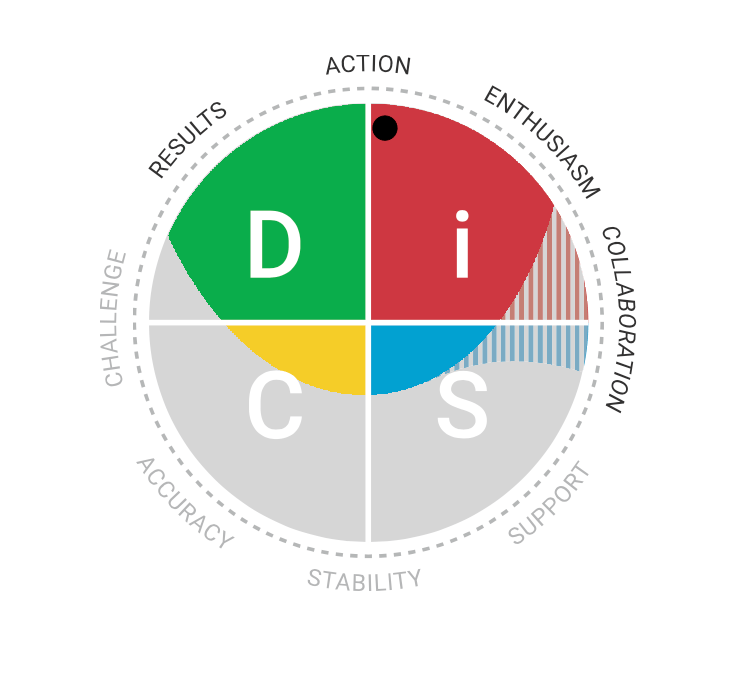
The most important idea in the model is that every style, and every priority, is equally valuable. Everyone is a blend of all four styles, and most of us operate within our styles and priorities with the least energy. Some of us are drawn to Results and Action, some to Enthusiasm and Collaboration, some to Support and Stability, and some to Accuracy and Challenge. Each brings real strengths, and each has blind spots.
But the people we work with don’t all share our priorities. The operator who values stability and support, the engineer who wants accuracy and the evidence first, the director who wants results by Friday: they each need something different from us. A Quality Leader who only ever works from their own priorities gets the best out of the people who happen to share them, and leaves everyone else under-served.
That’s the real lesson DiSC has taught me over the years. Whatever your natural style, the work is learning to lean into everybody else’s style.
When I laid the CQI’s nine domains over the eight DiSC Workplace priorities, I saw that the Quality Business Partner role asks for all the dimensions, not just the natural go-to one:
| CQI QBP domain | DiSC priorities it draws on most | What that looks like in practice |
|---|---|---|
| Strategic Integration, Foresight and Innovation | Action, Results | Spotting new opportunities early, taking the initiative and keeping the focus on outcomes that matter to the business |
| Organisational Influence | Enthusiasm, Collaboration | Building networks, bringing energy to the conversation and creating opportunities to work together |
| Developing Others, Adaptive Learning | Support, Collaboration | Being there to help, being patient with mistakes and encouraging teamwork so learning happens without blame |
| Risk Intelligent Oversight, Insight for Action | Accuracy, Challenge | Precise, reliable analysis and the courage to question assumptions before they become risks |
| Systemic Influence and Change, Political Acumen | Stability, Results | Pacing change so the system holds, while keeping momentum towards the outcome |
No single style covers all nine domains. A Quality Business Partner has to bring action to the boardroom, support to the shop floor, accuracy to the data and challenge to the assumptions, sometimes all in the same week.
Why Culture Is the Real Test
It would be easy to read all of this as a personal development exercise. Take your DiSC profile, stretch into a new style, become more influential. That’s part of it, but it misses the bigger point.
Business partnering doesn’t happen in a vacuum. The CQI research is clear that partners add value when they’re in the forums where budgets and trade-offs are set, and that effectiveness collapses when roles are ambiguous or when compliance work crowds out advisory time. Those are cultural conditions, not personal ones.
And culture is shaped by behaviour, including ours.
Whatever style a Quality Leader leads from, the organisation learns from it. If we only ever show up one way, only some people feel heard. Others stop bringing problems early, near misses go quiet, and quality becomes something done to teams rather than with them. The policing mindset resonates and doesn’t go away.
A Quality Leader who can offer Support when a team surfaces a failure, Collaboration when designing a new process, Action when bringing an opportunity to the board, and Accuracy when the evidence demands it, teaches the organisation something different. Quality is a partner for everyone, not just for the people who think like us. That’s what culture is: the sum of how people experience us, repeated over time.
This is also why the timing matters. ISO 9001:2026 now asks leadership to demonstrate commitment to quality culture explicitly, something I wrote about in my reflections on the 2026 transition. The standard is asking leaders to own culture. The CQI research is asking quality professionals to partner with those leaders. Everything DiSC gives both sides a shared language to do it without talking past each other.
If You Want to Be Seen as a Business Partner
Here are three things I’d encourage every Quality Leader to start this month:
- Know your home style, then map the people around you. If you’ve done a DiSC assessment, look honestly at where you naturally lead from. Then think about the five people you most need to influence. Where do they sit on the circle? The distance between you and them is where your development starts.
- Pick one CQI domain and one DiSC priority to stretch into. Don’t try to fix everything. If Organisational Influence is your gap, practise Enthusiasm or Collaboration behaviours in one recurring forum for 30 days. Keep a short journal of what changed in the room. They say it takes 30 days to make or break a habit!
- Audit your culture signals, not just your processes. Look at the last month: when someone raised a quality problem, what happened next? Did they get curiosity or correction? The answer tells you more about whether you’re seen as a partner than any KPI dashboard.
The Partner Is the One They Call First
A business partner isn’t defined by a job title. It’s defined by who gets the phone call when a big decision is still being shaped. The CQI has now given us an evidence-based picture of what that partner looks like. Everything DiSC gives us an honest mirror for how we show up, and a map of the styles we still need to learn to lean into.
The technical skills got most of us into quality. The range to lead every kind of person is what will get us sitting around the table.
I’d love to hear where you sit on this. Which of the nine domains comes naturally to you, and which one do you avoid? And if you’ve used DiSC with your leadership team, did it change how they saw the quality function? Drop your experience in the comments.
Quality isn’t alone in this shift. In my next post, I’ll look at how the PMI’s Dual Engines of Success research reaches a strikingly similar conclusion for project professionals. Enter your email below and follow the rest of this series on quality leadership and business partnering, so it lands in your feed.
You can learn more about Everything DiSC® and the Leadership Cohorts I run on my page or get in touch for an informal coffee chat!

