
A Good Year for Quality
It’s not often I get to write a post that’s purely self-reflective in this way, so I’m going to enjoy this one.
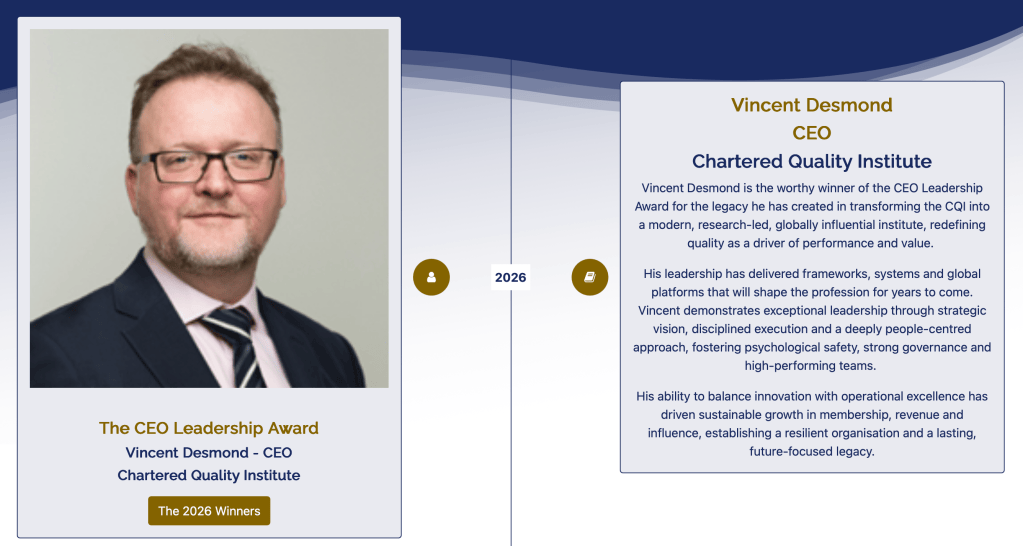
The Chartered Quality Institute has been shortlisted for The Professional Body of the year at the Memcom Awards. And on top of that, the CQI’s Chief Executive, Vince Desmond, has been named CEO of the Year. Congratulations to Vince, to the Board, and to the whole team that contributes to the success of this remarkable organisation. This kind of recognition is never one person’s work, and it’s never one year’s work either.
I want to say something about why I think it matters, though, because it’s easy to read award news, click like, and move on. I don’t think this one should be skimmed.
Recognition That Starts at the Top Table
The timing isn’t a coincidence. The CQI’s Board carries its duty with utmost care and commitment. This year, we engaged an independent organisation to review the effectiveness of our governance framework and the Board dynamics as part of our commitment to our own growth and improvement. The LSL Group recently published the findings of an independent Board Performance Review of the CQI, assessed across ten governance domains. The conclusion: the CQI is operating at a Mature level of governance, with a three-year ambition to reach Leading Practice and fifteen development actions agreed jointly by the Board and the Executive to get there.
Read that again as a Quality Leader. A professional body volunteered for an independent assessment, accepted where it stands, and turned the findings into an owned, prioritised improvement programme instead of a report that sits on a shelf. That’s not governance as compliance. That’s the improvement cycle we ask every organisation we work with to live by, applied to the people at the very top. It is powering performance in action.
As the chair of CQI, I put it simply in the review: like the profession it serves, the CQI “doesn’t stand still.” I’d argue that’s exactly what’s being recognised this year.
What Stood Out to Me
A few of the review’s strengths landed hard for me, because they’re the same things I keep coming back to.
Culture is doing the heavy lifting. The review points to trust, openness and constructive challenge in the boardroom: opposing views heard and weighed on their merits. That’s Quality culture, practised by leadership rather than delegated to a manual. It’s the same thing ISO 9001:2026 is now asking of every certified organisation’s leadership, and it’s good to see the profession’s own body modelling it.
The Board–Executive relationship is built on trust. I wrote recently about a transition I led where the real blocker wasn’t the standard. It was a quiet trust gap between leadership and the operating model. The CQI review describes the opposite: clear roles, mutual confidence, and a healthy balance of support and challenge. When that’s in place, organisations can move with agility instead of hesitating.
Governance is meant to enable, not constrain. The test the review offers is one every Quality Leader should borrow: does this process help us make better decisions, or just help us prove we followed one? That’s the difference between performative conformance and a system people actually trust. It’s the same point I made in why quality management earns its seat through integration.
Eyes on the future. A Board that consciously resists being dragged into operational detail so it can focus on the long-term is a Board that has done the work to trust its executive team. And an executive team that earns that trust is, I suspect, a big part of why a CEO of the Year award lands where it does.
Why This Matters for the Rest of Us
Here’s the bit I care about most. When the professional body for our discipline is recognised for how it leads and how it governs itself, it strengthens the case every one of us is trying to make inside our own organisations: that Quality is a leadership discipline, not a division.
It’s much easier to walk into a boardroom and talk about culture, trust and honest self-assessment when you can point to an example of it working at the top of our own profession. So if you’re a Quality Leader heading into a hard conversation this quarter, whether it’s your 2026 transition, a management review, or a trust gap nobody has named yet, borrow this story. Independent look. Honest result. Owned plan. Visible leadership.
And maybe take a moment to do what I suggested last time: find the good behaviour already there, however small, and thank the leader who made it possible.
And to that, here is my piece.
Thank you to every single member of the Board I have the privilege of serving alongside. You are the true representation of what this profession asks of everyone else: curious, willing to be challenged, and custodians of a brilliant Quality Culture.
Thank you, Vince, and the entire Exec team. The trusting relationship is a reflection of years of hard work and commitment to the Royal Charter we are proud to operate by.
And thank you to the CQI staff, volunteers and members around the world. Governance only matters because of what it makes possible for you, and you’re the reason any of us give our time to this.
Over to You
Congratulations again Vince, Mr CEO 2026!, and Congratulations to everyone at the CQI. Being shortlisted for a professional body of the year, standing right next to the Association of Business Mentors, and the Chartered Institute of Patent Attorneys is something I hold with utmost pride.
I’d love to hear from other members: what has the CQI done in the last year that’s made a difference to how you lead quality in your organisation? Drop it in the comments. And if you want to keep following the leadership side of quality, including the rest of the 2026 transition, hit follow or subscribe so it lands in your feed.

